Salman Saleem Find on Google+
Showing posts with label Google. Show all posts

Tuesday, December 17, 2013

Year-End Zeitgeist 2013 - Nelson Mandela, Paul Walker and iPhone 5s top Google Trends

Google has unveiled the results of Year-End Zeitgeist 2013, which illustrates the people, places, events and activities that captured the world's attention. Only a few have made to Google's trending list in its 13th edition of "the spirit of the times". Nelson Mandela, Paul Walker and iPhone 5s emerged as Top 3 global searches.


2013 Google Zeitgeist has presented more than 1000 top-ten lists from 72 countries with categories like Top Trending Searches, Trending People, Most Searched Events, Consumer Electronics and more. In something unique for this year, the Search Giant has combined its Zeitgeist with Google Trends. The late Cory Monteith, and the Harlem Shake rounded up the top five Trending Searches worldwide of 2013. The findings were revealed in a 2013 Zeitgeist post on Official Google Blog by Amit Singhal (+Amit Singhal), Senior Vice President and Google Fellow on 17 December 2013.


Google has made an interactive data visualization based 3D global map, displaying the top search trends of 2013 by day in cities worldwide, to enable people to parse through any major everyday popular searches. Users can readily rotate the globe, select a city and discover the subjects that made people to search on any day of the year, from international news to local sports. People take an international trip of the greatest instances from the last 12 months in their Year in Review video of 2013.


Saturday, September 28, 2013

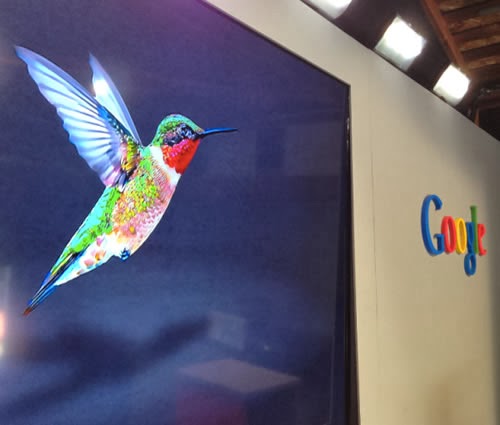
Effects of Google Hummingbird Search Algorithm on Content

Google has revealed Hummingbird Search Algorithm, the latest algorithm update since 2010's Caffeine update. It can be called another search results overhaul. But it is just a small part of an overall evolution to bring better information to consumers for the moments that matter.


Google is putting an effort to practice what they advocate all the time. Google has its sights set on becoming as the ultimate source of information. This new update is a clear indicator that Google is making bold moves to become an increasingly integral part of the life of people. This is not limited to supplying information that people want. But also provides intelligence that people did not even know they needed. Google is becoming to information, what Apple is to devices, in old school SAT analogy.

Content should satisfy Intent

Two years back, a shift was seen in web search from "plain" keyword optimization to a more "intent" based channel. Search Engines tried to "best guess" the intent of a search user. They matched it to the relevant content that most probably provided best answer of the query of a user. "Context" has entered search strategy lexicon recently, which accounts for more personalized search tactics based on location, platform, device and/or hyper local factors.

Announcement of Google Hummingbird update, which is incorporated for search ranking from last month, is a right step in this direction. Google is more emphasizing the importance of user intent over pure keyword based interpretation. This new update now better acknowledges context, timeliness, conversational search location cues, Knowledge Graph data and understanding of complex queries.

Content should be Rich

How marketing experts should concentrate on their content to fulfill complicated customer intent? Content is required to be unique, rich, in depth and explanatory, to be considered the most appropriate type of information for almost any search term. Websites which are presently creating rich content that try to response more extensive questions, instead of keywords or phrases, will improve their possibilities of positioning better with the new update. Although sites have to depend greatly on rich content, they also should continue to be properly-developed, which cause it to simpler for Google bots to discover that quality material.

Authorship markup by Google is Important

Because content seems to be the biggest emphasis for this update, it also likely means that authorship will become an even more important factor in optimization. It's interesting that this update is coming right on the heels of several recent notable changes. The first being the complete integration of secure search, which eliminated keyword data from analytics, and the second being Google+ rolling out a change to authorship, which will make it easier on Google to attribute content back to the author. So, while you start thinking about you content program, and whether or not it supports the new algorithm update, don’t forget to take authority into account. Make sure profiles are created, updated, and attributed for all pieces of content.

What will be the Future of Google Search after Hummingbird update?

It is difficult to estimate accurately what the future will be, because Google is obviously unforeseen, but it is easy to state that this upgrade is a obvious shift in the direction of far more Semantic Web, which targets obtaining improved realization of "aboutness" – not only from markup of entities, but in the capability to draw out message from the composition of a phrase – hence there may be possibly on its way in future. Probably the reply is within much more "implicit" search.

Regardless of whether Hummingbird basically alters search in future, its launch passed rather un-observed as just a minor enhancement in search results. Although Google mentioned that the update handles almost 90% of queries around the world, it will seem step-by-step improvement from user viewpoint. Nevertheless, the Marketers must be careful because since the enhancement delivers significant effects from both functional and technical perspectives. Google keeps on moving to a world in which "Content is King" and realizing end user search intent is the objective. Perhaps eventually it will be capable to solve our questions prior to we even inquire about them.

Friday, September 27, 2013

Google Unveiled Hummingbird Search Algorithm & Other Changes At 15th Birthday

Google announced a new "Hummingbird" search algorithm being live and especially designed to handle complex queries, celebrating the company's 15th birthday in the garage it was born. Big G also revealed a new design for tablets and phones, richer direct answers with comparison, a new song exploration feature and notifications of Google Now information for iOS 7. Hummingbird is especially useful for longer and more complex queries. It affects about 90% of Google searches worldwide. It is the first major upgrade for three years and has already been in use for about a month.


Hummingbird Search Algorithm replaced Caffeine

Amit Singhal, Senior Vice President of Search at Google said:
It took a long time to get results back then. More often than not, you forget what you were searching for in the first place. Now you can speak for searches and with Google Now get the right information at the right time. You should not be spending your time searching. You should be spending your time living.

We just changed Google's engines mid-flight again. Hummingbird is the company's most significant algorithm change since it switched to "Caffeine" in 2009.
Caffeine emphasized at better indexing of websites while focusing on speed and integrating social network results into search. Unlike its predecessor, Hummingbird is more focused on ranking information based on a more intelligent understanding of search requests.


Google stressed that a new algorithm is important as users expect more natural and conversational interactions with a search engine. They are using their voice to speak requests into mobile phones, smart watches and other wearable technology.

Hummingbird allows Google to more quickly parse full questions (as opposed to parsing searches word-by-word), and to identify and rank answers to those questions from the content they have indexed. It is more capable of understanding concepts and the relationships between them rather than simply words, which leads to more fluid interactions. In that sense, it is an extension of Google's "Knowledge Graph" concept introduced last year aimed at making interactions more human.

How the Hummingbird search algorithm affect Search Results?

Hummingbird algorithm is incorporated by Google for search positioning from about a month already. If any huge jumps or drops in your search engine placement have not been noticed, probably there would not be in near future also. If rankings did change, it could be due to Hummingbird. But it could also be due to some of the other parts of the Google search algorithm, which are always being changed and improved.

Google improved Voice Search

Google also showed off more advanced voice queries, in which your computer or tablet will answer back to you. Users can ask Google to compare two items, generate a list of songs from a particular artist, or pull statistics about the Eiffel Tower and receive a voice response. In the case of the Eiffel Tower, a user would need to say "Eiffel Tower" only once in a series of questions, and search will remember the context. Amit Singhal explained voice search further: "Voice will be fundamental to building future interactions with the devices [we use]".

Google disclosed Updated Version of Google Search app on iOS soon

Google also announced an updated version of the Google Search app on iOS, which is coming soon, according to Tamar Yehoshua, VP of Search for Google. The new app will allow users to more clearly see their calendar or events cards from the app's home screen, and reminders will now carry over between iOS and Android devices.

Happy Birthday Google

Search giant Google has turned 15. Huge progress and enormous developments have been made so far on coarse of turning Silicon Valley garage startup into the Search Engine leader. Timeline of Google presentrs a broad peak at the lifecycle of the brain child of co-founders Larry Page and Sergey Brin.

Wednesday, June 26, 2013

SEO Ranking Factors - Rank Correlation for Google USA in 2013 - Study by Searchmetrics

Staff at Searchmetrics have released results of their 3-month long study, SEO Ranking Factors – Rank Correlation 2013 for Google USA. They evaluated the first 30 search results of 10,000 keywords, hence they analyzed 300,000 websites. They also carried out Navigational Searches, filtering largely brand search in order to deliver better result. They searched through titles, descriptions, links, content, Facebook likes and shares, tweets, PlusOnes and more.

Marcus Tober, founder of Searchmetrics said that Ranking Factor – Rank Correlation - US 2013 study, like last year, dealt with the definition and evaluation of factors that differentiate better-positioned websites from pages placed further back in the organic search results – i.e., pages that have a positive rank correlation. Compared to their Google Ranking Factors US 2012 study, they taken significantly more ranking factors into account in their analysis.


Question studied by Searchmetrics:
What do web pages that are well-positioned by Google have in common and what distinguishes them from lower ranking pages?

What factors are playing a role?

You can find the most important factors in our overview of all rank correlation coefficients. These are all the factors we have analyzed and consider relevant. We have presented the relationship between Google search results and the various factors influencing it using the Spearman correlation - a high positive correlation coefficient occurs for a factor if higher ranking pages have that feature / or more of that feature, while lower ranking pages do not / or have less of that feature. In addition to providing an overview of the changes in correlation since last year, we have extended our analysis in 2013 to include many relevant new factors.


Top highlights of 2013:

1. Keyword domains and keyword links have lost relevance
2. Brands are the exception to many rules
3. Social signals continue to correlate very well with better rankings
4. Good content is always important: it comes to quality!
5. The number of backlinks remains immensely important
6. On-page technology remains one of the basics

Following are the Deeper Insights into the Study:

1. Keyword links and domains have lost relevance

The importance of keywords in the URL / domain has significantly decreased as a ranking factor compared to 2012:


In our study, these two factors are considered the losers when compared with last year, because the existence of keywords in the URL and/or the domain have lost their relevance. This also affects backlinks when it comes to plain text keyword links. So it looks as if the days of "hard keyword optimization" are over. Google now puts much more emphasis on natural link profiles. Hard keyword links have lost significant influence and can probably – when used excessively – even have a negative effect; for example, when Google updates its algorithm with features devaluing bad links. Wondering what else has been happening in the field of keywords? Check out the complete version of the Ranking Factors – Rank Correlation study.

2. Brands are the exception to many rules


Last year, brands held a privileged position. This has also been confirmed in this year's study: for brands – and their websites – search engines do not seem to apply the same criteria as for other domains. For example, it seems as though Google considers it natural for brands to have comparatively more backlinks with the name of the brand in the link text alone – what we refer to as "brand links" – and still not be rated negatively.

3. Social signals continue to correlate very well with better rankings

The tendency over the years has been very positive – and this year’s study confirms the trend that became evident as early as 2012: well positioned URLs have a high number of likes, shares, tweets and plus ones and specific URLs stand out in the top search results with a very high mass of social signals. On one hand this means that the activity on social networks continues to increase, on the other hand it means that frequently shared content increasingly correlates with good rankings.

4. Good content is always important: it comes to quality!

For our analysis of content features, we have increased the number of factors significantly over the previous year:


Content factors correlate almost entirely positively with good rankings and were apparently – when compared with the previous year – partially upgraded. Good ranking URLs, to a certain extent have more text and a higher number of additional media integrations compared with 2012. A good internal link structure also appears to be an important quality attribute.

5. The number of backlinks remains immensely important

Backlinks continue to be one of the most important SEO metrics. In this regard, little has changed over the years: sites with more backlinks simply rank better. And this is also the result of our ranking factor study in 2013. However, factors around this metric are subject to evolution: not only are the quantity of backlinks important, but increasingly so is their quality! The backlink profile is nowadays regarded as a kind of conglomerate of very diverse quality factors that we discuss in detail in the study.


6. On-page technology remains one of the basics

The on-page factors surrounding the technical side of building web sites have long been one of the basics of a good search engine ranking – and this will continue. Even more, it seems to be fulfilling certain on-page criteria is not about achieving a favorable ranking, rather, it is the opposite: it is simply negative for the rankings when web pages do not meet criteria. On-page factors are therefore considered more of a prerequisite for ranking higher in search results pages.


The context of the Ranking Factors - Rank Correlation Study:

Search engines work with algorithms to evaluate websites by topic and relevance. On this basis the search engines create a structure for the total of all pages in the search engine index, which finally results in a best possible ranking for users’ search queries. The criteria for the evaluation of websites and the production of this ranking are generally referred to as ranking factors. Please note the difference between correlation and causation in this case. We do not make any statements about causal effects between factors and rankings, but we analyze correlations: and the coexistence of a factor and rankings indicates some kind of relationship.

For our study, we have undertaken a comprehensive data collection which enables the analysis of the Ranking Factors for Google USA in 2013 and also allows us to draw comparisons to our analysis of the Ranking Factors in 2012. This content is an overview of our detailed Ranking Factors – Rank Correlation 2013 study. The results are based on correlation and are not proof of any causal effects.

Keep in touch with latest SEO News by following Marcus Tober at Goohle+ & Twitter and by visiting Searchmetrics SEO Blog.

Tuesday, March 12, 2013

Matt Cutts announced Google's new Penguin, Panda & Link Networks Updates

Matt Cutts, Google's head of search spam, announced Google's upcoming Penguin, Panda algorithms updates and new link network targets in 2013. He informed about it during The Search Police, SEO Track of the SMX West.

Panda Update Coming on this Friday or Monday
Matt revealed that a Panda Algorithm update will be released anytime from this coming Friday (15 March 2013) till Monday (18 March 2013). The last version was Panda Update 24, out on 22 January 2013. So the new Panda Update 25 is set to come after 8 weeks approximately.

Major Penguin Update in 2013
Matt Cutts also said that there will be a significant Penguin update in 2013. Google's search quality team is working on a large update to the Penguin algorithm. He thinks that it will be one of the more talked about Google algorithm updates of the year.

Penguin Update 1 was released on 24 April 2012 with 3.1% impact. Penguin Update 2 was out on 26 May 2012 with less than 0.1% effect. Penguin Update 3 came on 5 October 2012 with 0.3% change.

Link Network axing Confirmed
Matt Cutts confirmed that Google targeted a Link Network a couple weeks ago. Matt emaphasied that the Search Engine giant will go after more in 2013. He revealed that Google will release another update in the next week or two, that will specifically target another big link network.

Google penalized Russian Backlinks Network in first week of March 2013. Although the Big G did not reveal the name of the affectee, but it was rumored in Webmaster forums to be Russian based SAPE Links.

Reference(s):
Search Engine Land - http://searchengineland.com/googles-matt-cutts-on-upcoming-penguin-panda-link-networks-updates-151273
Search Engine Roundtable - http://www.seroundtable.com/google-penguin-four-16486.html

Thursday, March 7, 2013

Did Google penalize SAPE Links (another Link Network)?

Rumor floating around the SEO industry currently is that Google has crushed yet another link network, SAPE Links. Those using this paid service were supposedly penalized and downgraded in Google rankings over last two days. But not all webmasters agree it is the SAPE link network, rather they feel it may be a different network all together.


Dozens of threads are discussing about downgrades of Google rankings recently. Black Hat World and Black Hat Group have webmasters and SEOs who are hinting that it was due to SAPE Links. While others are not sure whether it is specific to SAPE or some other link network.

One webmaster wrote:
Anyone that use SAPE links see huge drop in rankings today?
Quite a number of Search professionals agreed but not all.

Google's head of search spam, Matt Cutts tweeted on 13 February 2013 that he was investigating "naughty Russian link selling software". And coincidently SAPE Links is a Russian link network.


Suggestions for Search Professionals and Webmasters:
Always avoid getting back-links from Link Networks. They may seem easy to get and can bring good Search Engine rankings early. But Google is all set to fight spam and low quality sites. Search Spam team of Big G cracks on culprits and penalizes and downgrads them in Google rankings. Always prepare unique content and get related quality back links. That will lead to top rankings in SERPs and qualified traffic.

Monday, February 25, 2013

Proper Keyword Distribution in Anchor Text for good Search Rankings

After the release of Penguin update by Google, sometime back SEOTacklebox did a webinar about keywords, linking and search ranking. Later they revisited that data after allowing plenty of time to gather more information and came to some conclusions about the best distribution of anchor text for ranking in Google.

It is well known by now that Google does not want people gaming their search algorithm. But still their search results are a product of computer generated algorithm. No person is sitting there to decide, which websites rank and which sites don't, for all search phrases. Due to this basic fact, there will always be ways to improve your search rankings by associating your site with what Google is looking for.

Link building for better search rankings is still necessary. Links are still the primary way, due to which Google decides what sites to rank where. The difference after Penguin update is that now the links need to be distributed in a natural manner rather than a keyword based manner. SEOMOZ published an article sometime ago, about the research on 10 national brand websites, that rank very well in the search engines. They broke down the percentages of links by anchor text. They came up with is a good formula for link building strategy.

Results found shown that about 65% of the links were exact match, phrase matching or brand matching with regards to the anchor text. The breakdown between these three categories was 18% exact match, 17% phrase match and 30% brand match. Remaining 35% back-links were evenly divided between the URL as the anchor text and other unrelated anchor text.


It presents a great scheme to design your own link building strategy. Using the ratios above, here is what a sample link building strategy might look like for a site, called "Widget World" selling "Red Widgets". For every 100 links built, the following should be done:

  • 18 links with anchor text of "Red Widgets" – this is the Exact match
  • 17 links with anchor text containing Red Widgets, such as "Handy Red Widgets", "Waterproof Red Widgets" etc – this is the Phrase match
  • 30 links with anchor text of "Widget World" or slight variation – this is the Brand
  • 18 links with the anchor text of "yoursitename.com" – this is the URL
  • 17 links with random anchor text – this could be long tail phrases like "see more about Red Widgets at our site" or simple phrases like "click here"


This is a simplistic breakdown, but the data backs up these general ratios as being the target. Regardless of whether the back links are built all naturally or built by you or outsourced, if you keep to this ratio you will not be degraded by Google, and you will see your search rankings increase.

When building these links, you can consider building higher page rank or PR links for the first line item – the exact match phrase. This will hopefully transfer a little more link juice through that phrase. When you combine that with the varied anchor text, adhering to these ratios, you have a winning formula for better search rankings.

Source(s):
http://seotacklebox.com/blog/proper-anchor-text-distribution-for-better-rankings/
http://www.seomoz.org/blog/anchor-text-distribution-avoiding-over-optimization

Thursday, February 7, 2013

Yahoo! & Google Team Up For Contextual Advertising

Yahoo! and Google have agreed to team up for Contextual Advertising. Yahoo has just lately finalized an international, non-exclusive contract with Google to show ads on different Yahoo! sites and specific co-branded sites using Google's AdSense for Content and Google's AdMob services. Google will start managing some of its AdSense display ads on Yahoo properties, and will become one of various ad systems Yahoo! uses to fill some of its pages. Now the two organizations will have a affiliation just like the one that Google has with online publishers: They provide Google entry to some of their unsold stock, and Google places small ads it operates on part of its advertisers.

Yahoo and Google had long talks about a more engaged ad tie in summer of 2012. That involved a situation where Yahoo would generally give over its ad serving features for all of its lower-priced ads to Google. Those discussions looked unsuccessful after interim Yahoo! CEO Ross Levinsohn was changed by Marissa Mayer. But since then Mayer has employed former vice president of Google's worldwide Partner Business Solutions group, Henrique De Castro as her chief operating officer.


It's worth wondering whether the AdSense ads will result in something bigger for Yahoo! or not? Yahoo has a long-term contract with Microsoft to manage its large search ad business. Marissa Mayer has openly mentioned her frustration with the way that partnership has proved unsuccessful for Yahoo. However, any really important bond between Yahoo! and Google would surely go through loads of regulating evaluation. Possibly the two organizations think what they are up to will not result in any issues in the US or Belgium.

Sara Gorman, a spokeswoman for Yahoo revealed that the ads will be displayed on Yahoo's web pages for finance, news, sports and autos. Yahoo stock increased 1.5 percent to $20.15 in long term dealing after the declaration of the new collaboration. eMarketer reported that Google is predicted to remain on top in the 17.7 billion U.S. dollars market for display ads this year, with 18% share, while Facebook will have 15% and Yahoo share will drop to 8 percent.

Refrence(s):
Yodel Anecdotal - http://ycorpblog.com/2013/02/06/contextual-advertising/
AllThingsD - http://allthingsd.com/20130206/coming-soon-to-yahoo-ads-from-google/
http://www.webpronews.com/google-and-yahoo-are-now-working-together-on-ads-2013-02
http://marketingland.com/yahoo-strikes-deal-to-run-contextual-ads-from-google-32799
http://www.sfgate.com/technology/article/Yahoo-teams-up-with-Google-on-ads-4258204.php

Tuesday, March 6, 2012

Google changed Link Evaluation criteria

What exactly did Google announce?
Google announced several changes of the ranking algorithm. The most important change was the change of the backlink analysis:

"Link evaluation. We often use characteristics of links to help us figure out the topic of a linked page. We have changed the way in which we evaluate links; in particular, we are turning off a method of link analysis that we used for several years. We often re-architect or turn off parts of our scoring in order to keep our system maintainable, clean and understandable."

What does this mean for your web page rankings?
Unfortunately, Google doesn't go into detail. As mentioned in Google's statement, Google uses "characteristics of links" to figure out the topic of a linked page.

Analyze Google

Characteristics of Links
We'll take a look at the characteristics below. Then we'll try to find out which element could have been changed.

Characteristic 1: the text of the link
The anchor text of a link has been the most important factor for a long time. If many sites link to a page with the anchor text "green apple" then the page will get high rankings for the term "green apple".

Characteristic 2: the link power of the linking page
Links from pages with many inbound links have a higher influence than links from pages with few backlinks.

Characteristic 3: content and page proximity
If you sell shoes on your website then the link to your website will have a bigger impact if the text that surrounds the link to your page is about shoes. If the link to your website is surrounded by totally unrelated text then the link won't count as much.

Characteristic 4: link attributes such as nofollow and title
Links that use the rel=nofollow attribute don't affect the position of your web pages on Google. Some webmasters think that using title attributes can have a positive effect if these contain the targeted keywords. Others think that this could trigger a spam filters.

Characteristic 5: redirects and shortened URLs
Redirects and shortened URLs such as http://bit.ly/a4X4th are URLs that redirect to another URL. Should these URLs carry full weight when it comes to calculate the position of a website?

Characteristic 6: the age of a website
The older a link is, the more Google tends to trust that link. Links that remain for a long time seem to have a bigger impact than links that come and go.

Characteristic 7: the affiliation of the linking sites
Links from websites that have the same owner and links from affiliates may have a different influence on the rankings of a web page than links from websites that are not affiliated with the page.

Of course, we can only speculate what Google has changed. It is likely that Google now only considers the anchor text of a link if that link is placed in the right context (page and content proximity). Another possibility is that affiliate links (redirected or with page variables) will have less influence on the rankings of a page. If you have followed the tips and tricks of this newsletter in the past then Google's change won't have any negative influence on your website rankings. Just continue to get good backlinks and optimize the content of your pages. You can analyze the different links that point to a website here.

References:
Search quality highlights: 40 changes for February
Google Changes How It Evaluates Links
How Google evaluates links: 7 characteristics

Saturday, March 12, 2011

Google extended Panda Search Algorithm update to English queries

Google has extended its Panda Update in search algorithm to English queries. Google had announced search algorithm change (known as "Farmer" or "Panda") in February 2011 for the US. Google Panda update has now been implemented on all English language queries. This includes both English speaking countries (such as searches on google.co.uk or google.com.au) and English queries in non-English countries (for instance, for a searcher using google.fr or google.de who's chosen English-language results).

The launch impacted nearly 12% of queries in the United States. The impact may be similar for English-speaking searchers across the world. Google claimed that they've gotten a lot of positive responses about the change: searchers are finding better results, and many great publishers are getting more traffic. Google said that based on testing, they've found the algorithm is very accurate at detecting site quality. Google has launched two ways for searchers to block particular sites from their search results recently. The first of these was a Chrome extension.

Google has now launched a block link directly in the search results that appears once a searcher has clicked from the results to a site and then return to the search results. Google said after the initial Panda launch, that they didn't use data about what sites searchers were blocking as a signal in the algorithm, but they did use the data as validation that the algorithm change was on target. Google found an 84% overlap in sites that were negatively impacted by Panda and sites that users had blocked with the Chrome extension.

Google are now using data about what searchers have blocked in "high confidence situations" as a secondary factor. With the initial launch of Panda Update, large sites were primarily affected, as the larger sites; with more pages, traffic, and links, have more signals available. By the latest update, smaller sites will see an impact. Amit Singhal, in charge of search quality at Google said: "this change also goes deeper into the "long tail" of low-quality websites to return higher-quality results where the algorithm might not have been able to make an assessment before".

References:
High-quality sites algorithm goes global, incorporates user feedback - Google Webmaster Central Blog
Panda 2.0: Google Rolls Out Panda Update Internationally & Incorporates Searcher Blocking Data - Search Engine Land

Friday, February 25, 2011

Google Panda Search Algorithm - Incorporated for Finding High-quality Sites in Search

Google has just modified its search algorithm and announced war on Content Farms. Amit Singhal (Google Fellow) and Matt Cutts (Principal Engineer) wrote in a blog post; the search upgrade, which will impact 11.8% of all Google search, "is developed to decrease positions for low-quality sites — sites which are low-value add for customers, duplicate content from other sites or sites that are just not very useful. Simultaneously, it will provide better positions for high-quality sites — sites with unique content and information such as research, in-depth reviews, careful research and so on."

Google can't launch a significant enhancement without impacting positions for many sites. Google is determined by the high-quality content developed by amazing sites around the world. Google has a liability to motivate a healthy web environment. Therefore, it is important for high-quality sites to be paid, and that's exactly what this algorithm modification is all about. This means that some sites will move up and some will drop after this modification.

Google Panda update does not depend on the reviews that Google obtained from the Personal Blocklist Firefox expansion, which was released earlier last week. But it definitely features the Blocklist information for the evaluation with the sites determined by the algorithm modification. Google has released this modification in the U.S. only right now; and plans to throw it out elsewhere eventually.

For more information about algorithm change refer to the post on Google Blog by Amit Singhal, Google Fellow, and Matt Cutts, Principal Engineer:
Finding more high-quality sites in search - Official Google Blog