Salman Saleem Find on Google+

Tuesday, December 3, 2013

Facebook updated News Feed Algorithm to display more High Quality Content like News Articles

Facebook has updated the News Feed algorithm to include links to more "high-quality" content like news articles in place of meme photos that redirect users to different sites. The move is to provide more relevant information to its users. Social Networking leader carried out intensive research before incorporating more "high-quality" articles into the News Feed area instead of latest memes. With this integration, users will more frequently see links to articles about current events, sports or politics.

Facebook engineering manager Varun Kacholia and software engineer Minwen Ji wrote in a post on the company's Newsroom on Monday, 2 December 2013:
We've noticed that people enjoy seeing articles on Facebook, and so we're now paying closer attention to what makes for high quality content, and how often articles are clicked on from News Feed on mobile.


The change will particularly be visible on mbile phones, as the company brings trending news on the go. This will easily provide users the knowledge of what's going on around the world and in their friends circle. Decision to reduce memes shouldn't have significant effect on users, as most people show interest in news articles over photos.

Facebook is also driving user engagement as the new algorithm change will sometimes bring few stories on top of the News Feed section, whenever new comments are added. This allows the users to keep the conversation going on.

Saturday, September 28, 2013

Effects of Google Hummingbird Search Algorithm on Content

Google has revealed Hummingbird Search Algorithm, the latest algorithm update since 2010's Caffeine update. It can be called another search results overhaul. But it is just a small part of an overall evolution to bring better information to consumers for the moments that matter.


Google is putting an effort to practice what they advocate all the time. Google has its sights set on becoming as the ultimate source of information. This new update is a clear indicator that Google is making bold moves to become an increasingly integral part of the life of people. This is not limited to supplying information that people want. But also provides intelligence that people did not even know they needed. Google is becoming to information, what Apple is to devices, in old school SAT analogy.

Content should satisfy Intent

Two years back, a shift was seen in web search from "plain" keyword optimization to a more "intent" based channel. Search Engines tried to "best guess" the intent of a search user. They matched it to the relevant content that most probably provided best answer of the query of a user. "Context" has entered search strategy lexicon recently, which accounts for more personalized search tactics based on location, platform, device and/or hyper local factors.

Announcement of Google Hummingbird update, which is incorporated for search ranking from last month, is a right step in this direction. Google is more emphasizing the importance of user intent over pure keyword based interpretation. This new update now better acknowledges context, timeliness, conversational search location cues, Knowledge Graph data and understanding of complex queries.

Content should be Rich

How marketing experts should concentrate on their content to fulfill complicated customer intent? Content is required to be unique, rich, in depth and explanatory, to be considered the most appropriate type of information for almost any search term. Websites which are presently creating rich content that try to response more extensive questions, instead of keywords or phrases, will improve their possibilities of positioning better with the new update. Although sites have to depend greatly on rich content, they also should continue to be properly-developed, which cause it to simpler for Google bots to discover that quality material.

Authorship markup by Google is Important

Because content seems to be the biggest emphasis for this update, it also likely means that authorship will become an even more important factor in optimization. It's interesting that this update is coming right on the heels of several recent notable changes. The first being the complete integration of secure search, which eliminated keyword data from analytics, and the second being Google+ rolling out a change to authorship, which will make it easier on Google to attribute content back to the author. So, while you start thinking about you content program, and whether or not it supports the new algorithm update, don’t forget to take authority into account. Make sure profiles are created, updated, and attributed for all pieces of content.

What will be the Future of Google Search after Hummingbird update?

It is difficult to estimate accurately what the future will be, because Google is obviously unforeseen, but it is easy to state that this upgrade is a obvious shift in the direction of far more Semantic Web, which targets obtaining improved realization of "aboutness" – not only from markup of entities, but in the capability to draw out message from the composition of a phrase – hence there may be possibly on its way in future. Probably the reply is within much more "implicit" search.

Regardless of whether Hummingbird basically alters search in future, its launch passed rather un-observed as just a minor enhancement in search results. Although Google mentioned that the update handles almost 90% of queries around the world, it will seem step-by-step improvement from user viewpoint. Nevertheless, the Marketers must be careful because since the enhancement delivers significant effects from both functional and technical perspectives. Google keeps on moving to a world in which "Content is King" and realizing end user search intent is the objective. Perhaps eventually it will be capable to solve our questions prior to we even inquire about them.

Friday, September 27, 2013

Google Unveiled Hummingbird Search Algorithm & Other Changes At 15th Birthday

Google announced a new "Hummingbird" search algorithm being live and especially designed to handle complex queries, celebrating the company's 15th birthday in the garage it was born. Big G also revealed a new design for tablets and phones, richer direct answers with comparison, a new song exploration feature and notifications of Google Now information for iOS 7. Hummingbird is especially useful for longer and more complex queries. It affects about 90% of Google searches worldwide. It is the first major upgrade for three years and has already been in use for about a month.


Hummingbird Search Algorithm replaced Caffeine

Amit Singhal, Senior Vice President of Search at Google said:
It took a long time to get results back then. More often than not, you forget what you were searching for in the first place. Now you can speak for searches and with Google Now get the right information at the right time. You should not be spending your time searching. You should be spending your time living.

We just changed Google's engines mid-flight again. Hummingbird is the company's most significant algorithm change since it switched to "Caffeine" in 2009.
Caffeine emphasized at better indexing of websites while focusing on speed and integrating social network results into search. Unlike its predecessor, Hummingbird is more focused on ranking information based on a more intelligent understanding of search requests.


Google stressed that a new algorithm is important as users expect more natural and conversational interactions with a search engine. They are using their voice to speak requests into mobile phones, smart watches and other wearable technology.

Hummingbird allows Google to more quickly parse full questions (as opposed to parsing searches word-by-word), and to identify and rank answers to those questions from the content they have indexed. It is more capable of understanding concepts and the relationships between them rather than simply words, which leads to more fluid interactions. In that sense, it is an extension of Google's "Knowledge Graph" concept introduced last year aimed at making interactions more human.

How the Hummingbird search algorithm affect Search Results?

Hummingbird algorithm is incorporated by Google for search positioning from about a month already. If any huge jumps or drops in your search engine placement have not been noticed, probably there would not be in near future also. If rankings did change, it could be due to Hummingbird. But it could also be due to some of the other parts of the Google search algorithm, which are always being changed and improved.

Google improved Voice Search

Google also showed off more advanced voice queries, in which your computer or tablet will answer back to you. Users can ask Google to compare two items, generate a list of songs from a particular artist, or pull statistics about the Eiffel Tower and receive a voice response. In the case of the Eiffel Tower, a user would need to say "Eiffel Tower" only once in a series of questions, and search will remember the context. Amit Singhal explained voice search further: "Voice will be fundamental to building future interactions with the devices [we use]".

Google disclosed Updated Version of Google Search app on iOS soon

Google also announced an updated version of the Google Search app on iOS, which is coming soon, according to Tamar Yehoshua, VP of Search for Google. The new app will allow users to more clearly see their calendar or events cards from the app's home screen, and reminders will now carry over between iOS and Android devices.

Happy Birthday Google

Search giant Google has turned 15. Huge progress and enormous developments have been made so far on coarse of turning Silicon Valley garage startup into the Search Engine leader. Timeline of Google presentrs a broad peak at the lifecycle of the brain child of co-founders Larry Page and Sergey Brin.

Saturday, August 31, 2013

Facebook testing Trending Topics section in News Feed

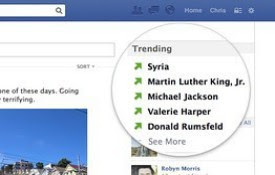
Facebook is testing a Trending Topics section in its News Feed. The social network is checking new ways to make Hashtags useful. The section is similar to "Trends Box" of rival Twitter and showcases topics, including Hash-tags, currently popular on the site.

Facebook testing Trending Topics

A spokeswoman from Facebook confirmed the test with The Wall Street Journal on Friday, 30 August 2013. She is quoted to have said the following in a WSJ Blog post about Trending:
"We are running a small test of a unit on News Feed that displays topics currently trending on Facebook. Right now it's only available to a small percentage of US users and it is still in the early stages of development. We will share more details down the line if we decide to roll it out more widely."

Facebook launched searchable Hashtags in June 2013, to make it easy for people to see related conversations around a single topic. At that time, the Social Networking company said it would be "rolling out a series of features that surface some of the interesting discussions people are having about public events, people, and topics". Earlier this month, it started showing trending topics to some mobile web users.

Trend based navigation is a natural outgrowth of adding Hashtags. Facebook is taking a while to go to the next phase. Public-private dynamics work quite differently on Facebook than on Twitter, where the hashtag / Trending Topics idea was popularized. Facebook is using tests to make sure this approach makes sense with its more private model. Let's see if Hashtag.org incorporates Facebook hashtags tracking in future.

Thursday, August 22, 2013

Winners of eCities of America in 2013

Scott Levitan, Director of Small Business Engagement, a division of Google, congratulated eCities of America in 2013. Google eCity Awards recognize the digital capitals of each state; whose businesses are using the worldwide web to find new customers, connect with existing customers and fuel their local economies. Across the USA, the online businesses expect to grow 40% faster.

Following is the detailed post which he wrote about 2013 US Digital Capitals on Google Official Blog:

I love to discover local gems that help make a community unique. Sometimes those gems can be around the corner—like Cafe Borrone, my favorite for Sunday brunch with my family; the food is great and even the dog is welcome on their patio. Sometimes I find those great places when I am on the road—places like Frank in Austin, Texas with their epic sausages or Boulevard Coffee in Ashland, Ore. which has great coffee and friendly people. Some of the best things I discover without even leaving home—like Casa Kids, which designs original children’s furniture from their studio in Brooklyn, N.Y., or Sticks in West Des Moines, Iowa, which sells hand-carved and hand-painted treasures.


The web helps people everywhere discover the best of what’s around the world or around the corner. Ninety-seven percent of Americans who use the Internet—pretty much all of us—look online for local products and services. So it should come as no surprise that the impact on businesses of being online is huge. According to a McKinsey study, small businesses that make use of the web are growing twice as fast as those that aren't on the web. Just as businesses that embrace the web grow faster, communities whose businesses embrace the web grow faster as well.

Given the importance of the web in growing our local businesses and our local economies, we worked with independent research firm IPSOS to analyze the online strength of local businesses in cities and towns across America. Businesses in these communities are embracing the power of the web to find new customers, connect with existing ones and fuel their local economies. Today we’re introducing the eCity Award winners for 2013—the strongest online business communities in each state.

2013 US eCities Winners


AL - Madison
AK - Homer
AZ - Scottsdale
AR - Bella Vista
CA - Carlsbad
CO - Boulder
CT - Glastonbury
DE - Bear
FL - Santa Rosa Beach
GA - Atlanta
HI - Kailua Kona
ID - Sandpoint
IL - Oak Brook
IN - Zionsville
IA - West Des Moines
KS - Lenexa
KY - Lexington

LA - Mandeville
ME - Scarborough
MD - Ocean City
MA - Westborough
MI - Walled Lake
MN - Minnetonka
MS - Ridgeland
MO - Maryland Heights
MT - Whitefish
NE - Lincoln
NV - Carson City
NH - Amherst
NJ - Princeton
NM - Albuquerque
NY - New York
NC - Cary
ND - Fargo

OH - Solon
OK - Edmond
OR - Ashland
PA - Exton
RI - Middletown
SC - N. Myrtle Beach
SD - Sioux Falls
TN - Hendersonville
TX - Austin
UT - Park City
VT - South Burlington
VA - Chantilly
WA - Bainbridge Island
WV - Charleston
WI - Pewaukee
WY - Casper

We hope these "digital capitals" are an inspiration to cities and businesses everywhere of what can be accomplished by embracing the web to grow. Congratulations to the 2013 eCities of America.

Source(s):
2013 eCities of America - Google Economic Impact
2013 eCities of America Award Winners

Wednesday, June 26, 2013

SEO Ranking Factors - Rank Correlation for Google USA in 2013 - Study by Searchmetrics

Staff at Searchmetrics have released results of their 3-month long study, SEO Ranking Factors – Rank Correlation 2013 for Google USA. They evaluated the first 30 search results of 10,000 keywords, hence they analyzed 300,000 websites. They also carried out Navigational Searches, filtering largely brand search in order to deliver better result. They searched through titles, descriptions, links, content, Facebook likes and shares, tweets, PlusOnes and more.

Marcus Tober, founder of Searchmetrics said that Ranking Factor – Rank Correlation - US 2013 study, like last year, dealt with the definition and evaluation of factors that differentiate better-positioned websites from pages placed further back in the organic search results – i.e., pages that have a positive rank correlation. Compared to their Google Ranking Factors US 2012 study, they taken significantly more ranking factors into account in their analysis.


Question studied by Searchmetrics:
What do web pages that are well-positioned by Google have in common and what distinguishes them from lower ranking pages?

What factors are playing a role?

You can find the most important factors in our overview of all rank correlation coefficients. These are all the factors we have analyzed and consider relevant. We have presented the relationship between Google search results and the various factors influencing it using the Spearman correlation - a high positive correlation coefficient occurs for a factor if higher ranking pages have that feature / or more of that feature, while lower ranking pages do not / or have less of that feature. In addition to providing an overview of the changes in correlation since last year, we have extended our analysis in 2013 to include many relevant new factors.


Top highlights of 2013:

1. Keyword domains and keyword links have lost relevance
2. Brands are the exception to many rules
3. Social signals continue to correlate very well with better rankings
4. Good content is always important: it comes to quality!
5. The number of backlinks remains immensely important
6. On-page technology remains one of the basics

Following are the Deeper Insights into the Study:

1. Keyword links and domains have lost relevance

The importance of keywords in the URL / domain has significantly decreased as a ranking factor compared to 2012:


In our study, these two factors are considered the losers when compared with last year, because the existence of keywords in the URL and/or the domain have lost their relevance. This also affects backlinks when it comes to plain text keyword links. So it looks as if the days of "hard keyword optimization" are over. Google now puts much more emphasis on natural link profiles. Hard keyword links have lost significant influence and can probably – when used excessively – even have a negative effect; for example, when Google updates its algorithm with features devaluing bad links. Wondering what else has been happening in the field of keywords? Check out the complete version of the Ranking Factors – Rank Correlation study.

2. Brands are the exception to many rules


Last year, brands held a privileged position. This has also been confirmed in this year's study: for brands – and their websites – search engines do not seem to apply the same criteria as for other domains. For example, it seems as though Google considers it natural for brands to have comparatively more backlinks with the name of the brand in the link text alone – what we refer to as "brand links" – and still not be rated negatively.

3. Social signals continue to correlate very well with better rankings

The tendency over the years has been very positive – and this year’s study confirms the trend that became evident as early as 2012: well positioned URLs have a high number of likes, shares, tweets and plus ones and specific URLs stand out in the top search results with a very high mass of social signals. On one hand this means that the activity on social networks continues to increase, on the other hand it means that frequently shared content increasingly correlates with good rankings.

4. Good content is always important: it comes to quality!

For our analysis of content features, we have increased the number of factors significantly over the previous year:


Content factors correlate almost entirely positively with good rankings and were apparently – when compared with the previous year – partially upgraded. Good ranking URLs, to a certain extent have more text and a higher number of additional media integrations compared with 2012. A good internal link structure also appears to be an important quality attribute.

5. The number of backlinks remains immensely important

Backlinks continue to be one of the most important SEO metrics. In this regard, little has changed over the years: sites with more backlinks simply rank better. And this is also the result of our ranking factor study in 2013. However, factors around this metric are subject to evolution: not only are the quantity of backlinks important, but increasingly so is their quality! The backlink profile is nowadays regarded as a kind of conglomerate of very diverse quality factors that we discuss in detail in the study.


6. On-page technology remains one of the basics

The on-page factors surrounding the technical side of building web sites have long been one of the basics of a good search engine ranking – and this will continue. Even more, it seems to be fulfilling certain on-page criteria is not about achieving a favorable ranking, rather, it is the opposite: it is simply negative for the rankings when web pages do not meet criteria. On-page factors are therefore considered more of a prerequisite for ranking higher in search results pages.


The context of the Ranking Factors - Rank Correlation Study:

Search engines work with algorithms to evaluate websites by topic and relevance. On this basis the search engines create a structure for the total of all pages in the search engine index, which finally results in a best possible ranking for users’ search queries. The criteria for the evaluation of websites and the production of this ranking are generally referred to as ranking factors. Please note the difference between correlation and causation in this case. We do not make any statements about causal effects between factors and rankings, but we analyze correlations: and the coexistence of a factor and rankings indicates some kind of relationship.

For our study, we have undertaken a comprehensive data collection which enables the analysis of the Ranking Factors for Google USA in 2013 and also allows us to draw comparisons to our analysis of the Ranking Factors in 2012. This content is an overview of our detailed Ranking Factors – Rank Correlation 2013 study. The results are based on correlation and are not proof of any causal effects.

Keep in touch with latest SEO News by following Marcus Tober at Goohle+ & Twitter and by visiting Searchmetrics SEO Blog.

Thursday, June 13, 2013

Facebook introduced Searchable Hashtags, Assured more Features to Discover Public Conversations

Facebook has announced to introduce Searchable Hashtags from 12 June 2013. Clickable Hash tags will show a feed of what other people and Pages are saying about that event or topic. Facebook hash-tags will allow users to add context to a post or indicate that it is part of a larger discussion.

The newly offered feature is similar to other services like Instagram, Twitter, Tumblr, or Pinterest. Search Engine giant Google is also offering hash-tags support in its social service Google+ already. Facebook members were able to include hashtags in their content earlier, but there was no real functionality. The renowned Social Networking website has said it would be "rolling out a series of features that surface some of the interesting discussions people are having about public events, people, and topics".

Facebook Hashtags NBAFinals

Facebook explained the reasoning behind the addition of Functional Hashtags feature in its blog post as following:
Every day, hundreds of millions of people use Facebook to share their thoughts on big moments happening all around them. Whether it's talking about a favorite television show, cheering on a hometown sports team or engaging with friends during a breaking news event—people on Facebook connect with their friends about what’s taking place all over the world.

To bring these conversations more to the forefront, we will be rolling out a series of features that surface some of the interesting discussions people are having about public events, people, and topics. As a first step, we are beginning to roll out hashtags on Facebook.
Facebook users now can do following:
  • Search for a specific hashtag from your search bar. For example, #NBAFinals
  • Click on hashtags that originate on other services, such as Instagram
  • Compose posts directly from the hashtag feed and search results

Privacy is a major concern in this new development. "Public Conversation" works differently on Facebook than it does on a service like Twitter, since many Facebook posts have some degree of privacy restriction. Facebook has assured that as always, members control the audience for their posts, including those with hash-tags. A company spokesperson has revealed that from a privacy perspective, hashtags will work similarly to Facebook Graph Search. In other words, users will only see the comments that they're authorized to see. So if you include a hashtag in a friends-only post, then my friends will still be the only ones who can see it in a hashtag search.

Introduction of Hash-tags is the first step by Facebook to help people more easily discover what others are saying about a specific topic and participate in public conversations. Social Media leader has committed to continue to offer more features in future, including trending hash tags and deeper insights, that help people discover and follow more of the world's conversations. Let's see if Hashtag.org tracks Facebook hashtags in future.